How to Plan a Daddy Daughter Dance Timeline (2 Hour Sample Agenda)
A daddy daughter dance timeline is the block by block plan for the night: what happens, when it starts, how long it runs, and who is handling it. A typical dance runs 2 hours and breaks into five or six blocks, plus a load in window before doors open. This guide walks through a real 2 hour agenda, the order those blocks should go in, and how to turn a rough agenda into a plan your volunteers can actually follow.
If you run the dance for a school, a church, or a community group, you know how it usually goes. The plan lives in an email thread, a shared doc somebody keeps editing, and a note on the committee chair's phone. Then the craft table runs long and nobody knows what moves. Watch the video above for the full walkthrough, then use the sections below as your reference.
Two notes on the video: it was recorded before the Ripluo rebrand, so you will hear the old name Event Builder Pro. And the free plan now covers up to 5 active events, not 3.
The 2 Hour Daddy Daughter Dance Timeline
Here is the agenda built in the video, for a school dance running 6:00 PM to 8:00 PM with about 100 people.
| Time | Block | Length |
|---|---|---|
| 4:30 PM | Load in and setup | 90 min |
| 6:00 PM | Welcome, arrival, and icebreaker | 15 min |
| 6:15 PM | Arts and crafts: crowns and ties station | 30 min |
| 6:45 PM | Desserts, drinks, photo area, and games around the room | 30 min |
| 7:15 PM | Up and moving game: the dance off | 30 min |
| 7:45 PM | The ring moment and slow dance | 15 min |
Copy the shape, not the exact minutes. A dance with 300 guests needs a longer dessert window. A dance with 40 needs a shorter one. What matters is the order, and that is the next section.
The Order That Keeps the Room From Going Flat
This is the part most committees get backwards, and it is worth pushing back on.
The first year, the school had planned it like this: active game with a ball early, then sit down for craft time, then get back up for something else. Up, down, up, down. That order fights you. Every time you ask a room of excited seven year olds to sit back down, you spend energy you already built, and you have to build it again from zero.
Build momentum instead. Start calm and climb.
- Start low. Arrival, a simple icebreaker, and the craft table. Dads and daughters are still walking in, still finding people they know. A seated craft is the right energy for a room that is still filling up.
- Step it up. Desserts, photos, and open games around the room. People are up and moving, but nobody is on stage yet.
- Go loud. The up and moving game. By now the room is warm and nobody feels self conscious.
- Land it. Open dance floor, then the quiet closing moment.
One climb, no dips. By the time you get to the dance floor everybody is already having a good time, so the floor fills instead of sitting empty while you beg people to come out.
Put Load In on the Timeline, Not in Your Head
The first version of the agenda in the video started at 6:00 PM with the welcome. That is a mistake worth naming, because it is the most common one.
Doors at 6:00 means you are in the building at 4:30. Tables, the craft station, the sound system, the photo backdrop, the dessert table. That is 90 minutes of real work with real owners, and if it is not on the timeline it is not a plan, it is a hope.
Put load in on the schedule as its own block. Then the volunteer showing up at 4:30 knows what they are walking into, and you are not the only person who knows what needs to happen before doors.
One small thing from the video worth stealing: when the load in block was missing, the fix was not to delete everything and start over. Every moment can be moved. Add the block, drag it to the top, and every time after it recalculates on its own.
Get the Desserts Out of the Way Early
Put the dessert window in the middle of the night, not at the end. Two reasons, and the second one is the one parents will thank you for.
- It runs interference. The dessert block doubles as the open window for the photo area and the games around the room. Some families want a picture while everybody still looks nice. Some want to play giant Jenga. Some just want to sit. One 30 minute block covers all three without you scheduling three things.
- Nobody wants to drive home with a kid full of sugar. Sugar at 7:45 goes home in the car and stays up past bedtime. Sugar at 6:45 gets burned off on the dance floor.
Draft the Agenda With AI, Then Build the Plan
The blank page is the slowest part of planning a dance. You can skip it.
Open any AI chat tool and ask for a first draft. The prompt from the video was close to this:
"Help me create a timeline and agenda for a 2 hour daddy daughter dance. Include arts and crafts, an up and moving game, and a dessert and drinks time."
Ask it to include supply lists for any craft, and you will get those too. What comes back is a starting point, not a finished plan. In the video the draft came back with the right idea for the order, and it still needed a load in block, real durations, and the closing moment added by hand.
Here is the split that matters. An AI chat gives you ideas. It does not give you a plan your team can run on the night. It cannot tell your craft volunteer when to be at the table, it will not recalculate every time after a block runs long, and it is not something you can hand to twelve people. That is the part you build in Ripluo.
If you would rather not leave the app for the first draft, Buildr AI generates a schedule inside Ripluo from a one sentence description, and the moments land on your timeline ready to edit.
How to Build This in Ripluo
Pulling off a great event means tracking a hundred moving details. Without a system built for it, they scatter across notes, spreadsheets, and a dozen apps. Ripluo gives you one place for every event detail: timelines, checklists, and tasks, easy to find and ready to use.
Here is the build from the video, step by step:
- Create the event. Name it, set the date, and set the start and end. Use your load in time as the start, not doors. In the video that was a 4:30 PM start and an 8:00 PM finish. Add the headcount and the event type while you are there.
- Open the schedule and add your first moment. Every item on a Ripluo timeline is a moment. Give it a title, a duration, and a description. Start with load in at 90 minutes.
- Paste the rest of the blocks in. Take the agenda from your AI draft and add a moment per block. Drop the supply list for the craft station straight into that moment's description, so the volunteer running the table has it where they need it.
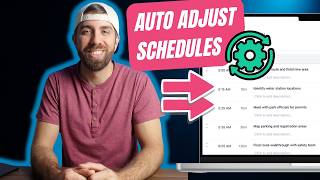
- Reorder instead of retyping. Drag any moment, or use the up and down arrows. Every start and end time after it updates automatically, so changing your mind costs you nothing.
- Assign the work. Add team instructions to each moment so the craft crew, the dessert table, and the DJ each see their own cue instead of reading everyone else's.
- Share it. Give the committee a read only public event page or export a PDF. No accounts, no attachments, no arguing about which version is current.
- Save it for next year. A school dance happens every year. Save the finished timeline as an event template and next year starts at 90 percent done instead of zero.
Add a checklist for everything that has to happen before load in day, like ordering the rings and buying the craft supplies, and a budget if the dance has to break even on ticket sales.
Plan the Closing Moment on Purpose
The last 15 minutes are the ones families remember, so give them their own block.
The one from the video: buy inexpensive rings, enough for every dad to have one per daughter he brought. Hand them out at check in or partway through the night, and tell the dads to hold onto them. Then at the end, slow the music down, dim the lights, and ask the dads to get down on one knee, look their daughter in the eye, and tell her one thing they love about her and one thing they love doing with her. Then he gives her the ring and they dance.
Then pick the energy back up for the last five or ten minutes and send everyone out happy.
That moment needs supplies bought in advance, a song picked in advance, and a script for whoever is on the microphone. All three are reasons it belongs on the timeline as a real block with a real owner, not as something you remember to do at 7:50.
Looking for what to put in the middle of the night? The companion guide has 10 daddy daughter dance games and activities, including the ring moment and the ones that need supplies ordered ahead.
Get Started for Free
Schedules, dynamic timelines, team instructions, checklists, budgets, public event pages, and PDF export are all included on the free plan, along with up to 5 active events. Create your free Ripluo account and build your daddy daughter dance timeline today.
Frequently Asked Questions
How long should a daddy daughter dance be?
Two hours is the standard for an elementary school age dance, and it is long enough to fit an icebreaker, a craft, a dessert window, a game, open dancing, and a closing moment without anyone getting restless. Younger crowds can run 90 minutes.
What order should daddy daughter dance activities go in?
Start calm and build up. Arrival and a craft first while the room is filling, then desserts and open games, then the big up and moving game, then the dance floor, then the quiet closing moment. Avoid bouncing between high energy and seated activities, because every time you ask the room to sit back down you lose the energy you just built.
When should we serve desserts at a daddy daughter dance?
Around the middle of the night rather than the end. It gives families a natural window for photos and open games at the same time, and it means the sugar gets burned off on the dance floor instead of in the car on the way home.
How much setup time do I need for a school dance?
Plan about 90 minutes of load in before doors for a 100 person dance with a craft station, a photo area, a dessert table, and sound. Put it on the timeline as its own block with owners assigned, rather than treating it as time that just happens.
Can I use AI to plan a daddy daughter dance?
Yes, for the first draft. Ask any AI chat tool for a 2 hour agenda with the activity types you want and it will give you blocks and supply lists to react to. It will not give you a plan your volunteers can run, so move the draft into a real schedule with durations, owners, and a load in block once you like the shape of it.
How many volunteers do I need for a daddy daughter dance?
It depends on how many stations you run. Count one owner per block that needs supervising, such as the craft table, the dessert table, the photo area, check in, and whoever is on the microphone, then add a floater. Assigning them inside each moment with team instructions is what keeps you from being the only person who knows the plan.
Is the schedule tool free in Ripluo?
Yes. Schedules, moments, dynamic time updates, team instructions, and PDF export are all included on the free plan, which covers up to 5 active events.